Monday, May 9, 2016

Red Riding Hood

Okay, so if you haven't figured it out already, I've been trying to cover these stories in the order I encountered them, because it's "nostalgia." However, after I get past that Richard Scarry VHS, it's kind of hard for me to figure out EXACTLY the precise order I encountered these stories in (even if I DO have a really good memory). So I'm covering these next few only ROUGHLY in order, as I encountered them around the same time. I'll start with "Red Riding Hood."

Now, in the early 90's there was a collection of books at was apparently printed in Canada by a company called "Tormont Publications." It was called, "The Great Fairy Tales Treasure Chest." I'm going to try to explain his clearly, because it took me awhile to figure out exactly how these books were published, and I'm not sure I'm even entirely correct. So bear with me. I'm trying to help you understand.

"Great Fairy Tales Treasure Chest" is a series of about five "series" if you know what I mean. Each "series" in the series in the series was composed of five tall, skinny books that were included in a tall, skinny box. Each "series" had its own box, as well as its own border. And they included wonderful illustrations by a guy with the pen-name of Tony Wolf, as well as (I think) one or two other illustrators.

Now, being born in the LATE nineties (rather than the early nineties, when these books were published), and living in AMERICA (rather than Canada), it would seem strange that we would have had any of these books at all. But we did have a few of them, though I don't know exactly where my parents even got them from.

From what I've gathered, it appears that the books that were from the first "series" we're also published individually without the numbers at the bottom of the books. You can see the books from series one in the picture below.


Now, we had books four and five of series one, but they were from the individually published versions, rather than the ones from the collection, so the volume numbers were not at the bottoms of the book covers. It appears that the individual versions also were different colors than the collection versions. As you can see from the picture, all the books from the collection version were blue. However, our copy of book four was green, and our copy of book five was pink. You can see the cover of book four below. It's the only picture I could find of it. And of course, ours was green instead of blue.


Now I'm sure you have two questions. The first is probably why I didn't post a picture of book five as well. The second is probably why I'm talking about these books so much. The answer to the first ties into the answer to the second. I will say that we eventually also got a copy of the complete series four, but that doesn't matter right now. About the two questions, book five actually has an interesting nostalgic value that I feel is worth talking about in a post of its own, so I'm saving a picture of it for when I do a post about it. And that won't be long from now either. I needed to introduce these books because it will make more sense when I post more about them later.

Now you've probably guessed from the title that book four has the story of "Red Riding Hood" in it. And yes, it does. It also has "The Ugly Duckling" and "The Obstinate Goats."

Now "Read Riding Hood" was popularized by French author Charles Perrault. His version of the story introduced most of the elements we know from the story today, such as the red hood. His version literally translates to "Little Red Riding Hood."

The story was made even more popular by the Brothers Grimm, who toned the story down quite a bit, and gave it a much less dark ending. Their version is "Rottkapchen" (I think that's how it's spelled), which is a diminutive form of "Red Cap" However, some translations of it for children still call it "Red Riding Hood."

Now, everybody probably knows this story already (aren't you tired of hearing that from me? LOL.).

There's a little girl who always wears a red hood. Her mother sends her into the woods (and out of the woods! and home before dark! LOL!) to bring food to her sick grandmother. She tells her not to leave the path, and not to talk to strangers. A wolf meets her on the way, and she foolishly tells him where her grandmother's house is. The wolf convinces her to leave the path to pick flowers, and then races the the grandmother's house and locks her in the closet. He dresses up as Grandmother and jumps into her bed. Red arrives at the house and suspects that something isn't right. She can tell that her grandmother isn't what she usually looks like, and just when she figures out it's the wolf, she's too late, and the wolf pounces on her. But before he can eat her, a hunter enters the house and shoots the wolf. He rescues Red and her grandmother, and Red promises to never talk to strangers, and never leave the path again.

Now, the majority of modern versions of the story are based on the Brothers Grimm version, and although it is very similar, there are quite a few differences.

The first is that the Brothers Grimm version doesn't focus on the talking to strangers aspect. At all. It's main focus is how Red is supposed to stay on the path. Talking to a wolf is apparently normal in this version. Red's fault is in taking the wolf's advice to leather path, which gives the wolf time to get to Grandmother's house first. And at the end, there's actually an epilogue where Red keeps true to her word and ignores the advice of the next wolf who tries to trick her into leaving the path, allowing her to get to Grandmother's house first and plan ahead to defeat the wolf. A very satisfying ending, in my opinion.

And the most memorable difference is that the wolf doesn't even lock grandmother in the closet. He eats her! And he eats Red too! And it turns out they were swallowed whole. And the hunter must have taken advice from the mother goat from "Wolf and the Seven Little Kids," because he does the exact same thing she did! And the wolf has the same fate!

Now granted, not all kids versions have used the revised ending I mentioned earlier. In fact, the version from "Great Fairy Takes Treasure Chest" actually combines both endings! The wolf eats both Red and her grandmother, the hunter shoots the wolf, and then cuts the protagonists alive from his stomach.

But if you thought the Grimm version was dark, just look at the Perrault version.

This version DOES focus on the talking to strangers aspect. The wolf convinces her to take the longer path, and he takes the shorter one. When Red arrives, he tells her to remove her clothes and get in bed with him. The story takes on the familiar "Red is suspicious" plot point, but after the wolf eats her, that's the end of the story! Yup, she's dead!

Some have interpreted this story as being about avoiding sex offenders, and while I get kind of tired of scholars interpreting nearly every fairy tale as having to do with... something like that, in this case, it actually seems like a pretty valid interpretation.

There are older versions of this story too. In some of them, the wolf tricks Red into drinking her grandmother's blood! And while quite a few end with the wolf eating her, there are some early versions where Red outsmarts the wolf by asking to use the outhouse. Then she goes outside and runs away! And they say that women are helpless in fairy tales!

I personally like the ending where Red dies the best. I think it really drives the point home that kids should not talk to strangers, and should stay on the path. But I don't mind the other endings. They are all very clever, and, to be fair, I grew up with the happy ending!Plus, as a guy who really likes the movie "Hoodwinked," (yes, that will get its own review someday) I can't resist a bit of comedy in these stories!

Now, next time, I'll get to another famous fairy tale that has a wolf as the antagonist. You can probably guess what it is already! ;-)


Wednesday, May 4, 2016

Golden Book Richard Scarry VHS: Part 2: The Bremen Town Musicians

Okay, so in my last post, I was talking about the "Richard Scarry's Old MacDonald's Farm and Other Stories" VHS. I talked about the adaptation of "The Wolf and the Seven Little Kids" that was on it. Today, I'm going to talk about the other fairy tale that was on it; "The Bremen Town Musicians."

Now, once again, this was my introduction to this story, so I kind of have a nostalgic feeling for it. This doesn't take as many liberties as "Wolf and the Seven Little Kids" did, but it still has quite a few differences.

I'm going to start by giving the plot of the Brothers Grimm tale.

A donkey, dog, cat, and rooster get away from their abusive owners, and head off toward the city of Bremen to become musicians. At night, they look for a place to rest, and discover the home of a band of robbers. They stand on top of each other and scare them away. They enter the house and fall asleep. One of the robbers returns to the house to investigate, and the animals attack him. He can't see very well in the dark and mistakes them for monsters. He runs away and tells his companions. They are scared, and run away, never to return. The animals decide they like the house so much at they stay there, and never go to Bremen.

Now, the funny thing about this story is that all of the humans in this story are antagonists. The animals are having to leave their abusive owners, and the robbers are humans. However, there are a few versions of this story that feature a human protagonists. In these versions, the human accompanies the animals on their journey, and they help him out. So, that's kind of interesting.

The plot of the story can vary too. Sometimes, there's hardly any plot, and it just states, "a donkey went on a journey, and he met a dog, and then they met a cat, etc." Sometimes, it has more of a plot, like the Grimm version does. The ending varies sometimes too. I've always preferred the ending where the robber thinks the animals are monsters, because it's always made me laugh. Especially how he thinks the rooster's "cock-doodle-doo" is "kill the robber, do!" LOL!

In other versions, the robber is able to see the animals, and knows what they are, and they end up killing him by tossing him back and forth. Sometimes, all the robbers return to the house and get killed! In some versions where the protagonist is a human, he takes the robber's stolen goods back to their rightful owners, and is rewarded with riches.

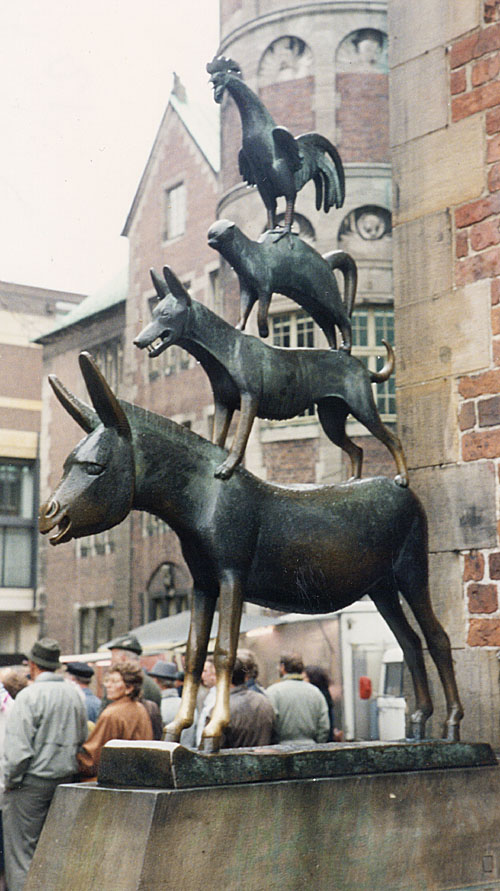
This story has still remained basically the same though. And you can actually see this statue in Bremen that's based on the story:


Now to talk about the Richard Scarry version.

At the point when this version was written, Scarry had stopped putting humans into his stories, and instead made all of the characters animals, which is kind of cool. So, in this version, instead of the animals running away from abusive owners, they are simply bored with the jobs they have at home, and long to become famous.

Of  course, the robbers are all animals also. One of them is the fox from Scarry's version of "Gingerbread Man," and another is the wolf from "Wolf and the Seven Little Kids" and "Three Little Pigs." Or, at least they look just like them.

Also, in a notable difference from the Grimm version, the animals don't actually realize that the men in the house are actually robbers in the Richard Scarry version. Instead, they think they are "friendly folk." And they end up scaring them away by accident, rather than on purpose, as they are trying to get invited in. They don't know what scared them away, and decide to wait in the house until they return, so that they can meet them. When one of the robbers returns to the house, they don't recognize him from before, and think that he's come to rob the house of the "friendly folk." So they attack him. The next morning, they notice that the "friendly folk" still haven't returned. They are afraid that the "robber" might return, so they agree to stay at the house to keep it safe and tidy until the "friendly folk" return. And since they never do return, and the animals never find out that they were robbers, they end up staying at the house forever. But they are content now, and live together happily.

Honestly, I don't know which version of the story I like better. They are both really cute stories about animals who go on a journey. And the moral of both versions is the same: You don't need to be rich and famous. What matters is having a nice house and a family.

I honestly can't decide whether I prefer the Grimm or the Richard Scarry version.

Which version of "Bremen Town Musicians" do YOU prefer?


Saturday, April 30, 2016

Golden Book Richard Scarry VHS: Part 1: The Wolf and the Seven Little Kids

So, in my last post, I said I'd be talking about a VHS I watched when I was a little kid. So, of course, that's what I'm going to talk about.

Now, when I was very little, some of the first VHS tapes that I had were made by the Golden Book company, and they each had a few stories on them that used pictures from the Little Golden Books along with voiceovers for the characters(with some of the pictures digitally edited to give them a "movie" feel).

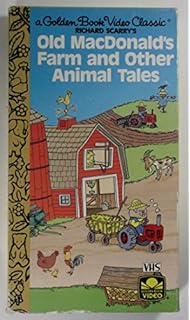
Now, even though I had about five different VHS tapes from this series at the same time, there was really only one that I watched when I was three. I wouldn't watch the other ones until quite a bit of time later. This particular VHS tape was titled, "Richard Scarry's Old MacDonald's Farm, and Other Animal Tales."


Now, I watched this video A LOT when I was young, and it was one of my favorites. I come across it  on YouTube sometimes, and I just HAVE to watch it, because I get all nostalgic. In fact, I re-watched it right before I came to write this post.

This VHS includes three stories by Richard Scarry. The first is about Old MacDonald, and how his kids throw a huge family reunion at his farm. Oh, and they grow pickles too, which is even funnier when you're an adult and watching this, because you know that pickles don't actually grow. You have to grow cucumbers and pickle them to get pickles!

The other two stories were Richard Scarry's adaptations of "The Wolf and the Seven Little Kids," and "The Bremen-town Musicians." These are both based on fairy tales, and since they were my introduction to BOTH stories, I decided to talk about them both. But, in order to keep my posts from being too long, I will cover "Bremen-town Musicians" in my next post, and just talk about "Wolf and the Seven Little Kids."

Now, before I begin, I strongly suggest watching this entire VHS before you read my thoughts about it, because it is HILARIOUS! The entire VHS has been up on YouTube for quite a few years, and you can watch the entire thing by clicking on this link.

The story is, of course, way softened in the Richard Scarry version. In the original, a wolf is trying to get into a house where seven young goats live while their mother is away, but they won't let him. He tricks them, and they let him in.

The original Brothers Grimm story implies that the wolf completely successful at his trickery, while the Richard Scarry version portrays him as a stereotypical idiot. And it is very funny. Plus, the kids get to slam the window on his fingers, so... Yeah!

In the original, the wolf swallows all the kids whole (except for one, who hides). He goes to rest under a tree, and the mother goat cuts him open, frees the kids, fills him with stones, and sews him back shut.

In the Richard Scarry version, the wolf puts all the kids in a sack, so that he can take them home and have a feast. While he's resting under the tree, the mother goat cuts open the sack, frees the kids, fills the sack with stones, and sews it back shut. Wouldn't it have been easier just to untie the sack?

The ending to the Richard Scarry version is COMPLETELY DIFFERENT from the original ending. In the original, the wolf takes a drink by the lake, and the heavy stones inside him cause him to fall in and drown.

In the Richard Scarry version, the wolf is completely humiliated! He gets home, opens the sack, and finds that there are stones in it instead of goats. He is angry and hungry, and the story doesn't end there! No! It has more to it, as the wolf gets humiliated more! He doesn't die at the end, but at the end, I'm sure he'd rather be dead than in the situation he's in! I'm not even going to spoil it for you. Watch it yourself, because it's hilarious!

I know this is kind of strange coming from a partial-purist, but I actually like the Richard Scarry version better than the original. Maybe it's just because of the nostalgia, but it's just SO funny! It's the version that always pops into my head when I hear "Wolf and the Seven Little Kids."

Next time, I'll get to the other story, "Bremen-town Musicians." Stay tuned!

Thursday, April 28, 2016

The Three Bears

Okay, so for my fairy tale posts, I decided to start with one of the first fairy tales I can remember being read to me; "The Three Bears."

Now, I was very, very, VERY young when this story was first read to me. I was two years old or younger. I had the book that you can see in the picture below (that is, you can see the picture if that stupid glitch doesn't happen).


Now, I'm sure everybody knows this story already, because it's one of the most famous fairy tales out there. Basically, it's this family of bears that go for a walk while their porridge is cooling, and a little girl named Goldilocks goes into their house and eats their porridge, sits in their chairs, and lays in their beds. Then the three bears come home. Their porridge bowls have been eaten out of, and their child's porridge is completely gone. Their chairs have been sat on, and their child's chair is broken. Their beds have been used, and Goldilocks is still in their child's bed. Goldilocks wakes up and sees the bears and runs away in fear, never to return again.

Now, of course, this book that had been read to me was a little kid version of the story. So, of course, it had an innocent little girl who survives at the very end. And the bears end up sharing their porridge in order for their son to have some after his is eaten, and they fix his chair. Yeah. It was for kids.

Now, I was one of those kids who wanted my favorite stories read to me over and over and over again. So this book got read to me about a million times, and I never got tired of it. In fact, this WAS the story of "The Three Bears" for me until I was about five years old, and my parents bought another book called, "The Golden Goose Book."


If it looks familier, it's because it's a very famous book that has illustrations by Leonard Leslie Brooke. His drawings in the book are fantastic and worth looking at if you haven't seen them. This book is in the public domain, and is on Project Gutenberg, so you can take a look at it if you want.

This book included the stories of "The Golden Goose," "The Three Bears," "The Three Little Pigs," and "Tom Thumb." My parents started reading me and my brothers "The Three Bears" out of this book, and we enjoyed it a lot. In this book, the girl who trespassed in the Bears' house was named "Goldenlocks" instead of "Goldilocks," which I thought was kind of funny.

I found out more about this story when I was in middle school (which is when I started looking into the older versions of the fairy tales). I found out that most modern versions are based on a story by Robert Southy I was surprised to find out that originally, the intruder was not a little girl at all. Instead, it was an old, ugly woman. And not only that, but the story describes many times how she uses bad language, and how she would have stolen the Bears' spoons if they had been made of silver instead of wood. And at the end, they leave it up to the reader what happens to her after she jumps out the window after the Bears discover her. It gives you the idea that maybe she broke her neck, or ran into the woods and was lost, or found her way out and was "taken up by the constable to the house of correction for the vagrant she was." Clearly, this was not the innocent story that most kids heard from their parents. This was a breaking and entering story.

But that wasn't the most surprising part. The most surprising part was that the Bears weren't even a family. We're used to hearing "Father Bear," "Mother Bear," and "Baby Bear." But in this version, they were "the Great Huge Bear," "The Middle Bear," and "The Little Small Wee Bear." And ALL THREE OF THEM were male bears! Haha! I'll let you have your own opinion on whether these Bears were just friends who lived in the same house or something more...adult.

The version of the story in "The Golden Goose Book" was Southy's version. But it had been edited to replace the Old Woman with Goldenlocks (as well as remove the nasty things that she does), and change the Middle Bear to female.

Apparently, the change from an Old Woman to a little girl first appeared about ten years after the story's publication, where she was replaced with a girl named "Silver-Hair." This girl apparently went through a lot of name changes before publishers decided that "Goldilocks" was the name that most people preferred.

Interestingly, there is a variant of this tale, called "Scrapefoot," which includes a fox as the intruder instead of a human. Joseph Jacobs thought that maybe when Southy heard the story, it had included a vixen (female fox) as the intruder, but he misunderstood "vixen" to mean "spiteful woman." That's a very plausible theory, in my opinion.

The funny thing about modern versions of this story is that they appear to make Goldilocks the character that most kids connect with. It's the character that they like to hear about the most, and they're happy when she escapes the Bears. In reality, it's really the BEARS that we should be connecting with. They're the ones who have trespassing problems. The intruder is the antagonist, not the hero, and I'm afraid that modern versions have made that hard for kids to realize. In fact, Roald Dahl made note of this in a parody poem he wrote of the story, where Goldilocks does really awful things in the Bears' house, and then gets eaten by them at the end!

All, in all, this story hasn't really changed that much from the older versions. But it's still worth noting that modern versions should probably cast Goldilocks in a more negative light, and make the Bears the characters that we identify with. 

As a story that I remember fondly as a kid, it's nice to go back and remember it. Next time... I'll be talking about a VHS tape that I watched as a little kid. What VHS is it? Well... You'll just have to wait and see!

Tuesday, April 26, 2016

Introduction

There was once a time-period where people were encouraged to use their imaginations. In this time-period, people would make up fantastic stories, which they would tell to people. The stories were very interesting, and they would be passed down from generation to generation for hundreds of years.

As the stories were passed down, they evolved, and more details were implemented into them. Sometimes people would take the familier stories, and make new stories out of them.

Then, one day, someone decided to try to write the stories down. And so he did. And when that happened, more people decided to try writing down the stories being told in their countries as well. Soon, many books had been written that contained these fantastic stories, which contained marvelous creatures like dwarfs and fairies. And these stories were enjoyed for many generations.

But alas, like most wonderful things in the world, these stories were soon taken over by more popular items.

The motion picture was invented, and it allowed people to watch stories play out on screen. Of course, these marvelous stories were prime choices for these new inventions, and we're soon put to screen. Unfortunately, many things that happened in these stories didn't play out very well on screen, and had to be changed. Many of the important parts of these stories lost their meaning in adaptation, and the factor that children would be watching the films increased the need to change the stories.

And, sadly, over the next hundred or so years, the people realized that they didn't need to read anymore, because they could just watch the stories play out on screen. So they got rid of most of their books, and watched these films almost every day. Little did they know that the stories they thought they knew were much different. But few people even cared anymore, and the versions of the stories on screen became the ones that people thought about when the stories were mentioned, and not the ones that had been written so long ago.

But there was still hope. For there was a collective group called the Nerds. The Nerds wrote many books about these stories, trying to release them to the public once again. They kept trying, over and over, for many years.

And soon, there came the arrival of an amazing invention, which allowed people to communicate with each other worldwide. It was called the Internet. The Nerds wasted no time in putting their thoughts on the Internet, and the results were fantastic. Many more people became Nerds as a result of this worldwide sensation, and many of the Nerds met each other as a result.

But still, the public at large didn't know about these stories. But did this stop the Nerds from trying? No.

In fact, more Nerds more born as the years went by, and more thoughts were contributed to the Internet.

One Nerd was born in the nineties. His name was Ozfan95, who was raised a Nerd from childbirth. He read many stories from these great time periods many, many times. He loved them so much. In sixth grade, he discovered many more of these stories at the Public Library, and decide to study them even more than he ever had. And he did, for many years afterwards.

And then, one day, he decided to share his thoughts about the stories on the Internet, just as many other Nerds had done for about twenty years. This is his blog.


I'm Ozfan95, and I'm not just some random person. I'm a Nerd, and I'm proud to be one. This blog will explain all about fairy tales, including those of the Brothers Grimm, Charles Perrault, and Joseph Jacobs, among others. While many others have written blogs on fairy tales in the past, every person's opinion matters. And so I'm here. And I dedicate this blog to everybody who loves these stories, and wants to hear more about them.

Enjoy!